
分享
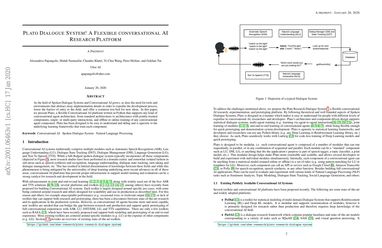
As the field of Spoken Dialogue Systems and Conversational AI grows, so does the need for tools and environments that abstract away implementation details in order to expedite the development process, lower the barrier of entry to the field, and offer a common test-bed for new ideas. In this paper, we present Plato, a flexible Conversational AI platform written in Python that supports any kind of conversational agent architecture, from standard architectures to architectures with jointly-trained components, single- or multi-party interactions, and offline or online training of any conversational agent component. Plato has been designed to be easy to understand and debug and is agnostic to the underlying learning frameworks that train each component.
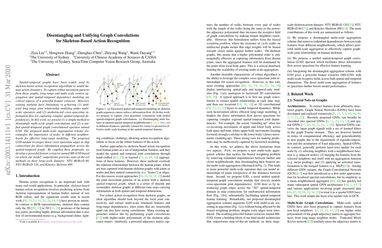
Spatial-temporal graphs have been widely used by skeleton-based action recognition algorithms to model human action dynamics. To capture robust movement patterns from these graphs, long-range and multi-scale context aggregation and spatial-temporal dependency modeling are critical aspects of a powerful feature extractor. However, existing methods have limitations in achieving (1) unbiased long-range joint relationship modeling under multi-scale operators and (2) unobstructed cross-spacetime information flow for capturing complex spatial-temporal dependencies. In this work, we present (1) a simple method to disentangle multi-scale graph convolutions and (2) a unified spatial-temporal graph convolutional operator named G3D. The proposed multi-scale aggregation scheme disentangles the importance of nodes in different neighborhoods for effective long-range modeling. The proposed G3D module leverages dense cross-spacetime edges as skip connections for direct information propagation across the spatial-temporal graph. By coupling these proposals, we develop a powerful feature extractor named MS-G3D based on which our model outperforms previous state-of-the-art methods on three large-scale datasets: NTU RGB+D 60, NTU RGB+D 120, and Kinetics Skeleton 400.
This paper presents fairseq S^2, a fairseq extension for speech synthesis. We implement a number of autoregressive (AR) and non-AR text-to-speech models, and their multi-speaker variants. To enable training speech synthesis models with less curated data, a number of preprocessing tools are built and their importance is shown empirically. To facilitate faster iteration of development and analysis, a suite of automatic metrics is included. Apart from the features added specifically for this extension, fairseq S^2 also benefits from the scalability offered by fairseq and can be easily integrated with other state-of-the-art systems provided in this framework. The code, documentation, and pre-trained models are available at https://github.com/pytorch/fairseq/tree/master/examples/speech_synthesis.
Voice conversion is a common speech synthesis task which can be solved in different ways depending on a particular real-world scenario. The most challenging one often referred to as one-shot many-to-many voice conversion consists in copying the target voice from only one reference utterance in the most general case when both source and target speakers do not belong to the training dataset. We present a scalable high-quality solution based on diffusion probabilistic modeling and demonstrate its superior quality compared to state-of-the-art one-shot voice conversion approaches. Moreover, focusing on real-time applications, we investigate general principles which can make diffusion models faster while keeping synthesis quality at a high level. As a result, we develop a novel Stochastic Differential Equations solver suitable for various diffusion model types and generative tasks as shown through empirical studies and justify it by theoretical analysis.
Non-autoregressive text-to-speech (NAR-TTS) models such as FastSpeech 2 and Glow-TTS can synthesize high-quality speech from the given text in parallel. After analyzing two kinds of generative NAR-TTS models (VAE and normalizing flow), we find that: VAE is good at capturing the long-range semantics features (e.g., prosody) even with small model size but suffers from blurry and unnatural results; and normalizing flow is good at reconstructing the frequency bin-wise details but performs poorly when the number of model parameters is limited. Inspired by these observations, to generate diverse speech with natural details and rich prosody using a lightweight architecture, we propose PortaSpeech, a portable and high-quality generative text-to-speech model. Specifically, 1) to model both the prosody and mel-spectrogram details accurately, we adopt a lightweight VAE with an enhanced prior followed by a flow-based post-net with strong conditional inputs as the main architecture. 2) To further compress the model size and memory footprint, we introduce the grouped parameter sharing mechanism to the affine coupling layers in the post-net. 3) To improve the expressiveness of synthesized speech and reduce the dependency on accurate fine-grained alignment between text and speech, we propose a linguistic encoder with mixture alignment combining hard inter-word alignment and soft intra-word alignment, which explicitly extracts word-level semantic information. Experimental results show that PortaSpeech outperforms other TTS models in both voice quality and prosody modeling in terms of subjective and objective evaluation metrics, and shows only a slight performance degradation when reducing the model parameters to 6.7M (about 4x model size and 3x runtime memory compression ratio compared with FastSpeech 2). Our extensive ablation studies demonstrate that each design in PortaSpeech is effective.
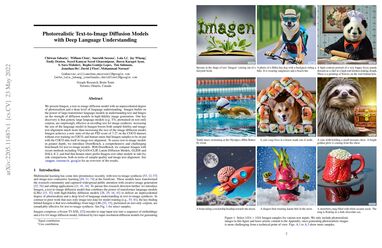
We present Imagen, a text-to-image diffusion model with an unprecedented degree of photorealism and a deep level of language understanding. Imagen builds on the power of large transformer language models in understanding text and hinges on the strength of diffusion models in high-fidelity image generation. Our key discovery is that generic large language models (e.g. T5), pretrained on text-only corpora, are surprisingly effective at encoding text for image synthesis: increasing the size of the language model in Imagen boosts both sample fidelity and image-text alignment much more than increasing the size of the image diffusion model. Imagen achieves a new state-of-the-art FID score of 7.27 on the COCO dataset, without ever training on COCO, and human raters find Imagen samples to be on par with the COCO data itself in image-text alignment. To assess text-to-image models in greater depth, we introduce DrawBench, a comprehensive and challenging benchmark for text-to-image models. With DrawBench, we compare Imagen with recent methods including VQ-GAN+CLIP, Latent Diffusion Models, and DALL-E 2, and find that human raters prefer Imagen over other models in side-by-side comparisons, both in terms of sample quality and image-text alignment. See https://imagen.research.google/ for an overview of the results.
In this work, we pursue a unified paradigm for multimodal pretraining to break the scaffolds of complex task/modality-specific customization. We propose OFA, a Task-Agnostic and Modality-Agnostic framework that supports Task Comprehensiveness. OFA unifies a diverse set of cross-modal and unimodal tasks, including image generation, visual grounding, image captioning, image classification, language modeling, etc., in a simple sequence-to-sequence learning framework. OFA follows the instruction-based learning in both pretraining and finetuning stages, requiring no extra task-specific layers for downstream tasks. In comparison with the recent state-of-the-art vision & language models that rely on extremely large cross-modal datasets, OFA is pretrained on only 20M publicly available image-text pairs. Despite its simplicity and relatively small-scale training data, OFA achieves new SOTAs in a series of cross-modal tasks while attaining highly competitive performances on uni-modal tasks. Our further analysis indicates that OFA can also effectively transfer to unseen tasks and unseen domains. Our code and models are publicly available at https://github.com/OFA-Sys/OFA.

This paper highlights the importance of personalization in large language models and introduces the LaMP benchmark -- a novel benchmark for training and evaluating language models for producing personalized outputs. LaMP offers a comprehensive evaluation framework with diverse language tasks and multiple entries for each user profile. It consists of seven personalized tasks, spanning three text classification and four text generation tasks. We additionally propose two retrieval augmentation approaches that retrieve personal items from each user profile for personalizing language model outputs. To this aim, we study various retrieval models, including term matching, semantic matching, and time-aware methods. Extensive experiments on LaMP for zero-shot and fine-tuned language models demonstrate the efficacy of the proposed retrieval augmentation approach and highlight the impact of personalization in various natural language tasks.

Recommendation foundation model utilizes large language models (LLM) for recommendation by converting recommendation tasks into natural language tasks. It enables generative recommendation which directly generates the item(s) to recommend rather than calculating a ranking score for each and every candidate item as in traditional recommendation models, simplifying the recommendation pipeline from multi-stage filtering to single-stage filtering. To avoid generating excessively long text and hallucinated recommendations when deciding which item(s) to recommend, creating LLM-compatible item IDs to uniquely identify each item is essential for recommendation foundation models. In this study, we systematically examine the item ID creation and indexing problem for recommendation foundation models, using P5 as an example of the backbone LLM. To emphasize the importance of item indexing, we first discuss the issues of several trivial item indexing methods, such as random indexing, title indexing, and independent indexing. We then propose four simple yet effective solutions, including sequential indexing, collaborative indexing, semantic (content-based) indexing, and hybrid indexing. Our study highlights the significant influence of item indexing methods on the performance of LLM-based recommendation, and our results on real-world datasets validate the effectiveness of our proposed solutions. The research also demonstrates how recent advances on language modeling and traditional IR principles such as indexing can help each other for better learning and inference. Source code and data are available at https://github.com/Wenyueh/LLM-RecSys-ID.

Evaluating the factuality of long-form text generated by large language models (LMs) is non-trivial because (1) generations often contain a mixture of supported and unsupported pieces of information, making binary judgments of quality inadequate, and (2) human evaluation is time-consuming and costly. In this paper, we introduce FACTSCORE, a new evaluation that breaks a generation into a series of atomic facts and computes the percentage of atomic facts supported by a reliable knowledge source. We conduct an extensive human evaluation to obtain FACTSCOREs of people biographies generated by several state-of-the-art commercial LMs -- InstructGPT, ChatGPT, and the retrieval-augmented PerplexityAI -- and report new analysis demonstrating the need for such a fine-grained score (e.g., ChatGPT only achieves 58%). Since human evaluation is costly, we also introduce an automated model that estimates FACTSCORE using retrieval and a strong language model, with less than a 2% error rate. Finally, we use this automated metric to evaluate 6,500 generations from a new set of 13 recent LMs that would have cost $26K if evaluated by humans, with various findings: GPT-4 and ChatGPT are more factual than public models, and Vicuna and Alpaca are some of the best public models. FACTSCORE is available for public use via `pip install factscore`.

We introduce CogVLM, a powerful open-source visual language foundation model. Different from the popular shallow alignment method which maps image features into the input space of language model, CogVLM bridges the gap between the frozen pretrained language model and image encoder by a trainable visual expert module in the attention and FFN layers. As a result, CogVLM enables deep fusion of vision language features without sacrificing any performance on NLP tasks. CogVLM-17B achieves state-of-the-art performance on 10 classic cross-modal benchmarks, including NoCaps, Flicker30k captioning, RefCOCO, RefCOCO+, RefCOCOg, Visual7W, GQA, ScienceQA, VizWiz VQA and TDIUC, and ranks the 2nd on VQAv2, OKVQA, TextVQA, COCO captioning, etc., surpassing or matching PaLI-X 55B. Codes and checkpoints are available at https://github.com/THUDM/CogVLM.

Click-through rate (CTR) prediction is one of the fundamental tasks for online advertising and recommendation. While multi-layer perceptron (MLP) serves as a core component in many deep CTR prediction models, it has been widely recognized that applying a vanilla MLP network alone is inefficient in learning multiplicative feature interactions. As such, many two-stream interaction models (e.g., DeepFM and DCN) have been proposed by integrating an MLP network with another dedicated network for enhanced CTR prediction. As the MLP stream learns feature interactions implicitly, existing research focuses mainly on enhancing explicit feature interactions in the complementary stream. In contrast, our empirical study shows that a well-tuned two-stream MLP model that simply combines two MLPs can even achieve surprisingly good performance, which has never been reported before by existing work. Based on this observation, we further propose feature gating and interaction aggregation layers that can be easily plugged to make an enhanced two-stream MLP model, FinalMLP. In this way, it not only enables differentiated feature inputs but also effectively fuses stream-level interactions across two streams. Our evaluation results on four open benchmark datasets as well as an online A/B test in our industrial system show that FinalMLP achieves better performance than many sophisticated two-stream CTR models. Our source code will be available at MindSpore/models.