
分享
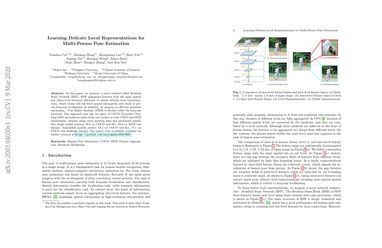
In this paper, we propose a novel method called Residual Steps Network (RSN). RSN aggregates features with the same spatial size (Intra-level features) efficiently to obtain delicate local representations, which retain rich low-level spatial information and result in precise keypoint localization. Additionally, we observe the output features contribute differently to final performance. To tackle this problem, we propose an efficient attention mechanism - Pose Refine Machine (PRM) to make a trade-off between local and global representations in output features and further refine the keypoint locations. Our approach won the 1st place of COCO Keypoint Challenge 2019 and achieves state-of-the-art results on both COCO and MPII benchmarks, without using extra training data and pretrained model. Our single model achieves 78.6 on COCO test-dev, 93.0 on MPII test dataset. Ensembled models achieve 79.2 on COCO test-dev, 77.1 on COCO test-challenge dataset. The source code is publicly available for further research at https://github.com/caiyuanhao1998/RSN/
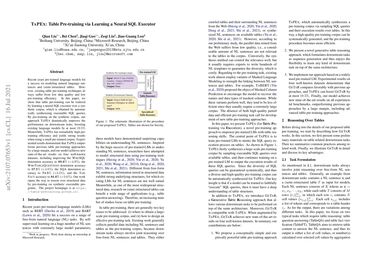
Recent progress in language model pre-training has achieved a great success via leveraging large-scale unstructured textual data. However, it is still a challenge to apply pre-training on structured tabular data due to the absence of large-scale high-quality tabular data. In this paper, we propose TAPEX to show that table pre-training can be achieved by learning a neural SQL executor over a synthetic corpus, which is obtained by automatically synthesizing executable SQL queries and their execution outputs. TAPEX addresses the data scarcity challenge via guiding the language model to mimic a SQL executor on the diverse, large-scale and high-quality synthetic corpus. We evaluate TAPEX on four benchmark datasets. Experimental results demonstrate that TAPEX outperforms previous table pre-training approaches by a large margin and achieves new state-of-the-art results on all of them. This includes the improvements on the weakly-supervised WikiSQL denotation accuracy to 89.5% (+2.3%), the WikiTableQuestions denotation accuracy to 57.5% (+4.8%), the SQA denotation accuracy to 74.5% (+3.5%), and the TabFact accuracy to 84.2% (+3.2%). To our knowledge, this is the first work to exploit table pre-training via synthetic executable programs and to achieve new state-of-the-art results on various downstream tasks. Our code can be found at https://github.com/microsoft/Table-Pretraining.
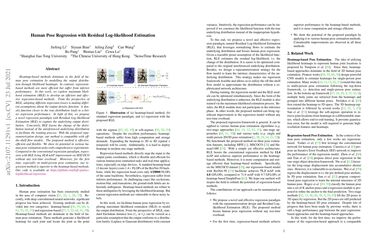
Heatmap-based methods dominate in the field of human pose estimation by modelling the output distribution through likelihood heatmaps. In contrast, regression-based methods are more efficient but suffer from inferior performance. In this work, we explore maximum likelihood estimation (MLE) to develop an efficient and effective regression-based methods. From the perspective of MLE, adopting different regression losses is making different assumptions about the output density function. A density function closer to the true distribution leads to a better regression performance. In light of this, we propose a novel regression paradigm with Residual Log-likelihood Estimation (RLE) to capture the underlying output distribution. Concretely, RLE learns the change of the distribution instead of the unreferenced underlying distribution to facilitate the training process. With the proposed reparameterization design, our method is compatible with off-the-shelf flow models. The proposed method is effective, efficient and flexible. We show its potential in various human pose estimation tasks with comprehensive experiments. Compared to the conventional regression paradigm, regression with RLE bring 12.4 mAP improvement on MSCOCO without any test-time overhead. Moreover, for the first time, especially on multi-person pose estimation, our regression method is superior to the heatmap-based methods. Our code is available at https://github.com/Jeff-sjtu/res-loglikelihood-regression
This paper presents fairseq S^2, a fairseq extension for speech synthesis. We implement a number of autoregressive (AR) and non-AR text-to-speech models, and their multi-speaker variants. To enable training speech synthesis models with less curated data, a number of preprocessing tools are built and their importance is shown empirically. To facilitate faster iteration of development and analysis, a suite of automatic metrics is included. Apart from the features added specifically for this extension, fairseq S^2 also benefits from the scalability offered by fairseq and can be easily integrated with other state-of-the-art systems provided in this framework. The code, documentation, and pre-trained models are available at https://github.com/pytorch/fairseq/tree/master/examples/speech_synthesis.
Voice conversion is a common speech synthesis task which can be solved in different ways depending on a particular real-world scenario. The most challenging one often referred to as one-shot many-to-many voice conversion consists in copying the target voice from only one reference utterance in the most general case when both source and target speakers do not belong to the training dataset. We present a scalable high-quality solution based on diffusion probabilistic modeling and demonstrate its superior quality compared to state-of-the-art one-shot voice conversion approaches. Moreover, focusing on real-time applications, we investigate general principles which can make diffusion models faster while keeping synthesis quality at a high level. As a result, we develop a novel Stochastic Differential Equations solver suitable for various diffusion model types and generative tasks as shown through empirical studies and justify it by theoretical analysis.
Non-autoregressive text-to-speech (NAR-TTS) models such as FastSpeech 2 and Glow-TTS can synthesize high-quality speech from the given text in parallel. After analyzing two kinds of generative NAR-TTS models (VAE and normalizing flow), we find that: VAE is good at capturing the long-range semantics features (e.g., prosody) even with small model size but suffers from blurry and unnatural results; and normalizing flow is good at reconstructing the frequency bin-wise details but performs poorly when the number of model parameters is limited. Inspired by these observations, to generate diverse speech with natural details and rich prosody using a lightweight architecture, we propose PortaSpeech, a portable and high-quality generative text-to-speech model. Specifically, 1) to model both the prosody and mel-spectrogram details accurately, we adopt a lightweight VAE with an enhanced prior followed by a flow-based post-net with strong conditional inputs as the main architecture. 2) To further compress the model size and memory footprint, we introduce the grouped parameter sharing mechanism to the affine coupling layers in the post-net. 3) To improve the expressiveness of synthesized speech and reduce the dependency on accurate fine-grained alignment between text and speech, we propose a linguistic encoder with mixture alignment combining hard inter-word alignment and soft intra-word alignment, which explicitly extracts word-level semantic information. Experimental results show that PortaSpeech outperforms other TTS models in both voice quality and prosody modeling in terms of subjective and objective evaluation metrics, and shows only a slight performance degradation when reducing the model parameters to 6.7M (about 4x model size and 3x runtime memory compression ratio compared with FastSpeech 2). Our extensive ablation studies demonstrate that each design in PortaSpeech is effective.

How do large language models (LLMs) develop and evolve over the course of training? How do these patterns change as models scale? To answer these questions, we introduce \textit{Pythia}, a suite of 16 LLMs all trained on public data seen in the exact same order and ranging in size from 70M to 12B parameters. We provide public access to 154 checkpoints for each one of the 16 models, alongside tools to download and reconstruct their exact training dataloaders for further study. We intend \textit{Pythia} to facilitate research in many areas, and we present several case studies including novel results in memorization, term frequency effects on few-shot performance, and reducing gender bias. We demonstrate that this highly controlled setup can be used to yield novel insights toward LLMs and their training dynamics. Trained models, analysis code, training code, and training data can be found at \url{https://github.com/EleutherAI/pythia}.

Recommendation foundation model utilizes large language models (LLM) for recommendation by converting recommendation tasks into natural language tasks. It enables generative recommendation which directly generates the item(s) to recommend rather than calculating a ranking score for each and every candidate item as in traditional recommendation models, simplifying the recommendation pipeline from multi-stage filtering to single-stage filtering. To avoid generating excessively long text and hallucinated recommendations when deciding which item(s) to recommend, creating LLM-compatible item IDs to uniquely identify each item is essential for recommendation foundation models. In this study, we systematically examine the item ID creation and indexing problem for recommendation foundation models, using P5 as an example of the backbone LLM. To emphasize the importance of item indexing, we first discuss the issues of several trivial item indexing methods, such as random indexing, title indexing, and independent indexing. We then propose four simple yet effective solutions, including sequential indexing, collaborative indexing, semantic (content-based) indexing, and hybrid indexing. Our study highlights the significant influence of item indexing methods on the performance of LLM-based recommendation, and our results on real-world datasets validate the effectiveness of our proposed solutions. The research also demonstrates how recent advances on language modeling and traditional IR principles such as indexing can help each other for better learning and inference. Source code and data are available at https://github.com/Wenyueh/LLM-RecSys-ID.

We introduce CogVLM, a powerful open-source visual language foundation model. Different from the popular shallow alignment method which maps image features into the input space of language model, CogVLM bridges the gap between the frozen pretrained language model and image encoder by a trainable visual expert module in the attention and FFN layers. As a result, CogVLM enables deep fusion of vision language features without sacrificing any performance on NLP tasks. CogVLM-17B achieves state-of-the-art performance on 10 classic cross-modal benchmarks, including NoCaps, Flicker30k captioning, RefCOCO, RefCOCO+, RefCOCOg, Visual7W, GQA, ScienceQA, VizWiz VQA and TDIUC, and ranks the 2nd on VQAv2, OKVQA, TextVQA, COCO captioning, etc., surpassing or matching PaLI-X 55B. Codes and checkpoints are available at https://github.com/THUDM/CogVLM.

Despite the recent progress in enhancing the efficacy of image deblurring, the limited decoding capability constrains the upper limit of State-Of-The-Art (SOTA) methods. This paper proposes a pioneering work, Adaptive Patch Exiting Reversible Decoder (AdaRevD), to explore their insufficient decoding capability. By inheriting the weights of the well-trained encoder, we refactor a reversible decoder which scales up the single-decoder training to multi-decoder training while remaining GPU memory-friendly. Meanwhile, we show that our reversible structure gradually disentangles high-level degradation degree and low-level blur pattern (residual of the blur image and its sharp counterpart) from compact degradation representation. Besides, due to the spatially-variant motion blur kernels, different blur patches have various deblurring difficulties. We further introduce a classifier to learn the degradation degree of image patches, enabling them to exit at different sub-decoders for speedup. Experiments show that our AdaRevD pushes the limit of image deblurring, e.g., achieving 34.60 dB in PSNR on GoPro dataset.

With the rapid development of deep convolutional neural network, face detection has made great progress in recent years. WIDER FACE dataset, as a main benchmark, contributes greatly to this area. A large amount of methods have been put forward where PyramidBox designs an effective data augmentation strategy (Data-anchor-sampling) and context-based module for face detector. In this report, we improve each part to further boost the performance, including Balanced-data-anchor-sampling, Dual-PyramidAnchors and Dense Context Module. Specifically, Balanced-data-anchor-sampling obtains more uniform sampling of faces with different sizes. Dual-PyramidAnchors facilitate feature learning by introducing progressive anchor loss. Dense Context Module with dense connection not only enlarges receptive filed, but also passes information efficiently. Integrating these techniques, PyramidBox++ is constructed and achieves state-of-the-art performance in hard set.

Click-through rate (CTR) prediction is one of the fundamental tasks for online advertising and recommendation. While multi-layer perceptron (MLP) serves as a core component in many deep CTR prediction models, it has been widely recognized that applying a vanilla MLP network alone is inefficient in learning multiplicative feature interactions. As such, many two-stream interaction models (e.g., DeepFM and DCN) have been proposed by integrating an MLP network with another dedicated network for enhanced CTR prediction. As the MLP stream learns feature interactions implicitly, existing research focuses mainly on enhancing explicit feature interactions in the complementary stream. In contrast, our empirical study shows that a well-tuned two-stream MLP model that simply combines two MLPs can even achieve surprisingly good performance, which has never been reported before by existing work. Based on this observation, we further propose feature gating and interaction aggregation layers that can be easily plugged to make an enhanced two-stream MLP model, FinalMLP. In this way, it not only enables differentiated feature inputs but also effectively fuses stream-level interactions across two streams. Our evaluation results on four open benchmark datasets as well as an online A/B test in our industrial system show that FinalMLP achieves better performance than many sophisticated two-stream CTR models. Our source code will be available at MindSpore/models.