
分享
End-to-end task-oriented dialogue is challenging since knowledge bases are usually large, dynamic and hard to incorporate into a learning framework. We propose the global-to-local memory pointer (GLMP) networks to address this issue. In our model, a global memory encoder and a local memory decoder are proposed to share external knowledge. The encoder encodes dialogue history, modifies global contextual representation, and generates a global memory pointer. The decoder first generates a sketch response with unfilled slots. Next, it passes the global memory pointer to filter the external knowledge for relevant information, then instantiates the slots via the local memory pointers. We empirically show that our model can improve copy accuracy and mitigate the common out-of-vocabulary problem. As a result, GLMP is able to improve over the previous state-of-the-art models in both simulated bAbI Dialogue dataset and human-human Stanford Multi-domain Dialogue dataset on automatic and human evaluation.
We present a new method for separating a mixed audio sequence, in which multiple voices speak simultaneously. The new method employs gated neural networks that are trained to separate the voices at multiple processing steps, while maintaining the speaker in each output channel fixed. A different model is trained for every number of possible speakers, and the model with the largest number of speakers is employed to select the actual number of speakers in a given sample. Our method greatly outperforms the current state of the art, which, as we show, is not competitive for more than two speakers.
In this paper, we propose a novel method called Residual Steps Network (RSN). RSN aggregates features with the same spatial size (Intra-level features) efficiently to obtain delicate local representations, which retain rich low-level spatial information and result in precise keypoint localization. Additionally, we observe the output features contribute differently to final performance. To tackle this problem, we propose an efficient attention mechanism - Pose Refine Machine (PRM) to make a trade-off between local and global representations in output features and further refine the keypoint locations. Our approach won the 1st place of COCO Keypoint Challenge 2019 and achieves state-of-the-art results on both COCO and MPII benchmarks, without using extra training data and pretrained model. Our single model achieves 78.6 on COCO test-dev, 93.0 on MPII test dataset. Ensembled models achieve 79.2 on COCO test-dev, 77.1 on COCO test-challenge dataset. The source code is publicly available for further research at https://github.com/caiyuanhao1998/RSN/

Human pose estimation has achieved significant progress in recent years. However, most of the recent methods focus on improving accuracy using complicated models and ignoring real-time efficiency. To achieve a better trade-off between accuracy and efficiency, we propose a novel neural architecture search (NAS) method, termed ViPNAS, to search networks in both spatial and temporal levels for fast online video pose estimation. In the spatial level, we carefully design the search space with five different dimensions including network depth, width, kernel size, group number, and attentions. In the temporal level, we search from a series of temporal feature fusions to optimize the total accuracy and speed across multiple video frames. To the best of our knowledge, we are the first to search for the temporal feature fusion and automatic computation allocation in videos. Extensive experiments demonstrate the effectiveness of our approach on the challenging COCO2017 and PoseTrack2018 datasets. Our discovered model family, S-ViPNAS and T-ViPNAS, achieve significantly higher inference speed (CPU real-time) without sacrificing the accuracy compared to the previous state-of-the-art methods.
Recent progress in language model pre-training has achieved a great success via leveraging large-scale unstructured textual data. However, it is still a challenge to apply pre-training on structured tabular data due to the absence of large-scale high-quality tabular data. In this paper, we propose TAPEX to show that table pre-training can be achieved by learning a neural SQL executor over a synthetic corpus, which is obtained by automatically synthesizing executable SQL queries and their execution outputs. TAPEX addresses the data scarcity challenge via guiding the language model to mimic a SQL executor on the diverse, large-scale and high-quality synthetic corpus. We evaluate TAPEX on four benchmark datasets. Experimental results demonstrate that TAPEX outperforms previous table pre-training approaches by a large margin and achieves new state-of-the-art results on all of them. This includes the improvements on the weakly-supervised WikiSQL denotation accuracy to 89.5% (+2.3%), the WikiTableQuestions denotation accuracy to 57.5% (+4.8%), the SQA denotation accuracy to 74.5% (+3.5%), and the TabFact accuracy to 84.2% (+3.2%). To our knowledge, this is the first work to exploit table pre-training via synthetic executable programs and to achieve new state-of-the-art results on various downstream tasks. Our code can be found at https://github.com/microsoft/Table-Pretraining.
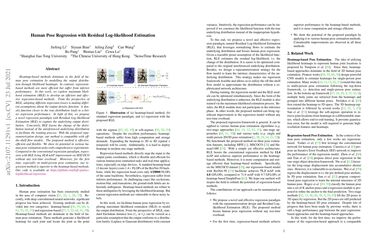
Heatmap-based methods dominate in the field of human pose estimation by modelling the output distribution through likelihood heatmaps. In contrast, regression-based methods are more efficient but suffer from inferior performance. In this work, we explore maximum likelihood estimation (MLE) to develop an efficient and effective regression-based methods. From the perspective of MLE, adopting different regression losses is making different assumptions about the output density function. A density function closer to the true distribution leads to a better regression performance. In light of this, we propose a novel regression paradigm with Residual Log-likelihood Estimation (RLE) to capture the underlying output distribution. Concretely, RLE learns the change of the distribution instead of the unreferenced underlying distribution to facilitate the training process. With the proposed reparameterization design, our method is compatible with off-the-shelf flow models. The proposed method is effective, efficient and flexible. We show its potential in various human pose estimation tasks with comprehensive experiments. Compared to the conventional regression paradigm, regression with RLE bring 12.4 mAP improvement on MSCOCO without any test-time overhead. Moreover, for the first time, especially on multi-person pose estimation, our regression method is superior to the heatmap-based methods. Our code is available at https://github.com/Jeff-sjtu/res-loglikelihood-regression
This paper presents fairseq S^2, a fairseq extension for speech synthesis. We implement a number of autoregressive (AR) and non-AR text-to-speech models, and their multi-speaker variants. To enable training speech synthesis models with less curated data, a number of preprocessing tools are built and their importance is shown empirically. To facilitate faster iteration of development and analysis, a suite of automatic metrics is included. Apart from the features added specifically for this extension, fairseq S^2 also benefits from the scalability offered by fairseq and can be easily integrated with other state-of-the-art systems provided in this framework. The code, documentation, and pre-trained models are available at https://github.com/pytorch/fairseq/tree/master/examples/speech_synthesis.
Recent studies have shown that multilingual pretrained language models can be effectively improved with cross-lingual alignment information from Wikipedia entities. However, existing methods only exploit entity information in pretraining and do not explicitly use entities in downstream tasks. In this study, we explore the effectiveness of leveraging entity representations for downstream cross-lingual tasks. We train a multilingual language model with 24 languages with entity representations and show the model consistently outperforms word-based pretrained models in various cross-lingual transfer tasks. We also analyze the model and the key insight is that incorporating entity representations into the input allows us to extract more language-agnostic features. We also evaluate the model with a multilingual cloze prompt task with the mLAMA dataset. We show that entity-based prompt elicits correct factual knowledge more likely than using only word representations. Our source code and pretrained models are available at https://github.com/studio-ousia/luke.
Recent work has shown pre-trained language models capture social biases from the large amounts of text they are trained on. This has attracted attention to developing techniques that mitigate such biases. In this work, we perform an empirical survey of five recently proposed bias mitigation techniques: Counterfactual Data Augmentation (CDA), Dropout, Iterative Nullspace Projection, Self-Debias, and SentenceDebias. We quantify the effectiveness of each technique using three intrinsic bias benchmarks while also measuring the impact of these techniques on a model's language modeling ability, as well as its performance on downstream NLU tasks. We experimentally find that: (1) Self-Debias is the strongest debiasing technique, obtaining improved scores on all bias benchmarks; (2) Current debiasing techniques perform less consistently when mitigating non-gender biases; And (3) improvements on bias benchmarks such as StereoSet and CrowS-Pairs by using debiasing strategies are often accompanied by a decrease in language modeling ability, making it difficult to determine whether the bias mitigation was effective.

Visual anomaly classification and segmentation are vital for automating industrial quality inspection. The focus of prior research in the field has been on training custom models for each quality inspection task, which requires task-specific images and annotation. In this paper we move away from this regime, addressing zero-shot and few-normal-shot anomaly classification and segmentation. Recently CLIP, a vision-language model, has shown revolutionary generality with competitive zero-/few-shot performance in comparison to full-supervision. But CLIP falls short on anomaly classification and segmentation tasks. Hence, we propose window-based CLIP (WinCLIP) with (1) a compositional ensemble on state words and prompt templates and (2) efficient extraction and aggregation of window/patch/image-level features aligned with text. We also propose its few-normal-shot extension WinCLIP+, which uses complementary information from normal images. In MVTec-AD (and VisA), without further tuning, WinCLIP achieves 91.8%/85.1% (78.1%/79.6%) AUROC in zero-shot anomaly classification and segmentation while WinCLIP+ does 93.1%/95.2% (83.8%/96.4%) in 1-normal-shot, surpassing state-of-the-art by large margins.

How do large language models (LLMs) develop and evolve over the course of training? How do these patterns change as models scale? To answer these questions, we introduce \textit{Pythia}, a suite of 16 LLMs all trained on public data seen in the exact same order and ranging in size from 70M to 12B parameters. We provide public access to 154 checkpoints for each one of the 16 models, alongside tools to download and reconstruct their exact training dataloaders for further study. We intend \textit{Pythia} to facilitate research in many areas, and we present several case studies including novel results in memorization, term frequency effects on few-shot performance, and reducing gender bias. We demonstrate that this highly controlled setup can be used to yield novel insights toward LLMs and their training dynamics. Trained models, analysis code, training code, and training data can be found at \url{https://github.com/EleutherAI/pythia}.

This paper highlights the importance of personalization in large language models and introduces the LaMP benchmark -- a novel benchmark for training and evaluating language models for producing personalized outputs. LaMP offers a comprehensive evaluation framework with diverse language tasks and multiple entries for each user profile. It consists of seven personalized tasks, spanning three text classification and four text generation tasks. We additionally propose two retrieval augmentation approaches that retrieve personal items from each user profile for personalizing language model outputs. To this aim, we study various retrieval models, including term matching, semantic matching, and time-aware methods. Extensive experiments on LaMP for zero-shot and fine-tuned language models demonstrate the efficacy of the proposed retrieval augmentation approach and highlight the impact of personalization in various natural language tasks.