
分享
Financial sentiment analysis is a challenging task due to the specialized language and lack of labeled data in that domain. General-purpose models are not effective enough because of the specialized language used in a financial context. We hypothesize that pre-trained language models can help with this problem because they require fewer labeled examples and they can be further trained on domain-specific corpora. We introduce FinBERT, a language model based on BERT, to tackle NLP tasks in the financial domain. Our results show improvement in every measured metric on current state-of-the-art results for two financial sentiment analysis datasets. We find that even with a smaller training set and fine-tuning only a part of the model, FinBERT outperforms state-of-the-art machine learning methods.
This paper presents our pioneering effort for emotion recognition in conversation (ERC) with pre-trained language models. Unlike regular documents, conversational utterances appear alternately from different parties and are usually organized as hierarchical structures in previous work. Such structures are not conducive to the application of pre-trained language models such as XLNet. To address this issue, we propose an all-in-one XLNet model, namely DialogXL, with enhanced memory to store longer historical context and dialog-aware self-attention to deal with the multi-party structures. Specifically, we first modify the recurrence mechanism of XLNet from segment-level to utterance-level in order to better model the conversational data. Second, we introduce dialog-aware self-attention in replacement of the vanilla self-attention in XLNet to capture useful intra- and inter-speaker dependencies. Extensive experiments are conducted on four ERC benchmarks with mainstream models presented for comparison. The experimental results show that the proposed model outperforms the baselines on all the datasets. Several other experiments such as ablation study and error analysis are also conducted and the results confirm the role of the critical modules of DialogXL.
Human skeleton, as a compact representation of human action, has received increasing attention in recent years. Many skeleton-based action recognition methods adopt graph convolutional networks (GCN) to extract features on top of human skeletons. Despite the positive results shown in previous works, GCN-based methods are subject to limitations in robustness, interoperability, and scalability. In this work, we propose PoseC3D, a new approach to skeleton-based action recognition, which relies on a 3D heatmap stack instead of a graph sequence as the base representation of human skeletons. Compared to GCN-based methods, PoseC3D is more effective in learning spatiotemporal features, more robust against pose estimation noises, and generalizes better in cross-dataset settings. Also, PoseC3D can handle multiple-person scenarios without additional computation cost, and its features can be easily integrated with other modalities at early fusion stages, which provides a great design space to further boost the performance. On four challenging datasets, PoseC3D consistently obtains superior performance, when used alone on skeletons and in combination with the RGB modality.
In this paper, we abandon the dominant complex language model and rethink the linguistic learning process in the scene text recognition. Different from previous methods considering the visual and linguistic information in two separate structures, we propose a Visual Language Modeling Network (VisionLAN), which views the visual and linguistic information as a union by directly enduing the vision model with language capability. Specially, we introduce the text recognition of character-wise occluded feature maps in the training stage. Such operation guides the vision model to use not only the visual texture of characters, but also the linguistic information in visual context for recognition when the visual cues are confused (e.g. occlusion, noise, etc.). As the linguistic information is acquired along with visual features without the need of extra language model, VisionLAN significantly improves the speed by 39% and adaptively considers the linguistic information to enhance the visual features for accurate recognition. Furthermore, an Occlusion Scene Text (OST) dataset is proposed to evaluate the performance on the case of missing character-wise visual cues. The state of-the-art results on several benchmarks prove our effectiveness. Code and dataset are available at https://github.com/wangyuxin87/VisionLAN.
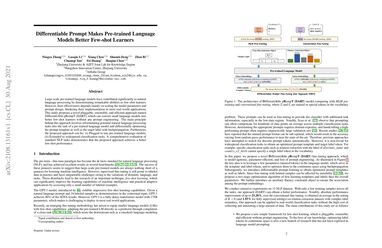
Large-scale pre-trained language models have contributed significantly to natural language processing by demonstrating remarkable abilities as few-shot learners. However, their effectiveness depends mainly on scaling the model parameters and prompt design, hindering their implementation in most real-world applications. This study proposes a novel pluggable, extensible, and efficient approach named DifferentiAble pRompT (DART), which can convert small language models into better few-shot learners without any prompt engineering. The main principle behind this approach involves reformulating potential natural language processing tasks into the task of a pre-trained language model and differentially optimizing the prompt template as well as the target label with backpropagation. Furthermore, the proposed approach can be: (i) Plugged to any pre-trained language models; (ii) Extended to widespread classification tasks. A comprehensive evaluation of standard NLP tasks demonstrates that the proposed approach achieves a better few-shot performance. Code is available in https://github.com/zjunlp/DART.
This paper presents fairseq S^2, a fairseq extension for speech synthesis. We implement a number of autoregressive (AR) and non-AR text-to-speech models, and their multi-speaker variants. To enable training speech synthesis models with less curated data, a number of preprocessing tools are built and their importance is shown empirically. To facilitate faster iteration of development and analysis, a suite of automatic metrics is included. Apart from the features added specifically for this extension, fairseq S^2 also benefits from the scalability offered by fairseq and can be easily integrated with other state-of-the-art systems provided in this framework. The code, documentation, and pre-trained models are available at https://github.com/pytorch/fairseq/tree/master/examples/speech_synthesis.
Self-supervised learning (SSL) is a long-standing goal for speech processing, since it utilizes large-scale unlabeled data and avoids extensive human labeling. Recent years witness great successes in applying self-supervised learning in speech recognition, while limited exploration was attempted in applying SSL for modeling speaker characteristics. In this paper, we aim to improve the existing SSL framework for speaker representation learning. Two methods are introduced for enhancing the unsupervised speaker information extraction. First, we apply the multi-task learning to the current SSL framework, where we integrate the utterance-wise contrastive loss with the SSL objective function. Second, for better speaker discrimination, we propose an utterance mixing strategy for data augmentation, where additional overlapped utterances are created unsupervisely and incorporate during training. We integrate the proposed methods into the HuBERT framework. Experiment results on SUPERB benchmark show that the proposed system achieves state-of-the-art performance in universal representation learning, especially for speaker identification oriented tasks. An ablation study is performed verifying the efficacy of each proposed method. Finally, we scale up training dataset to 94 thousand hours public audio data and achieve further performance improvement in all SUPERB tasks.
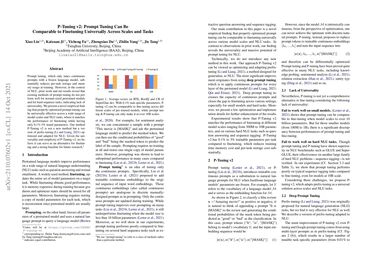
Prompt tuning, which only tunes continuous prompts with a frozen language model, substantially reduces per-task storage and memory usage at training. However, in the context of NLU, prior work reveals that prompt tuning does not perform well for normal-sized pretrained models. We also find that existing methods of prompt tuning cannot handle hard sequence labeling tasks, indicating a lack of universality. We present a novel empirical finding that properly optimized prompt tuning can be universally effective across a wide range of model scales and NLU tasks. It matches the performance of finetuning while having only 0.1%-3% tuned parameters. Our method P-Tuning v2 is an implementation of Deep Prompt Tuning \cite{li2021prefix,qin2021learning} optimized and adapted for NLU. Given the universality and simplicity of P-Tuning v2, we believe it can serve as an alternative to finetuning and a strong baseline for future research.Our code and data are released at https://github.com/THUDM/P-tuning-v2.

Multi-head attention layers, as used in the Transformer neural sequence model, are a powerful alternative to RNNs for moving information across and between sequences. While training these layers is generally fast and simple, due to parallelizability across the length of the sequence, incremental inference (where such paralleization is impossible) is often slow, due to the memory-bandwidth cost of repeatedly loading the large "keys" and "values" tensors. We propose a variant called multi-query attention, where the keys and values are shared across all of the different attention "heads", greatly reducing the size of these tensors and hence the memory bandwidth requirements of incremental decoding. We verify experimentally that the resulting models can indeed be much faster to decode, and incur only minor quality degradation from the baseline.

Visual anomaly classification and segmentation are vital for automating industrial quality inspection. The focus of prior research in the field has been on training custom models for each quality inspection task, which requires task-specific images and annotation. In this paper we move away from this regime, addressing zero-shot and few-normal-shot anomaly classification and segmentation. Recently CLIP, a vision-language model, has shown revolutionary generality with competitive zero-/few-shot performance in comparison to full-supervision. But CLIP falls short on anomaly classification and segmentation tasks. Hence, we propose window-based CLIP (WinCLIP) with (1) a compositional ensemble on state words and prompt templates and (2) efficient extraction and aggregation of window/patch/image-level features aligned with text. We also propose its few-normal-shot extension WinCLIP+, which uses complementary information from normal images. In MVTec-AD (and VisA), without further tuning, WinCLIP achieves 91.8%/85.1% (78.1%/79.6%) AUROC in zero-shot anomaly classification and segmentation while WinCLIP+ does 93.1%/95.2% (83.8%/96.4%) in 1-normal-shot, surpassing state-of-the-art by large margins.

Text-to-audio (TTA) system has recently gained attention for its ability to synthesize general audio based on text descriptions. However, previous studies in TTA have limited generation quality with high computational costs. In this study, we propose AudioLDM, a TTA system that is built on a latent space to learn the continuous audio representations from contrastive language-audio pretraining (CLAP) latents. The pretrained CLAP models enable us to train LDMs with audio embedding while providing text embedding as a condition during sampling. By learning the latent representations of audio signals and their compositions without modeling the cross-modal relationship, AudioLDM is advantageous in both generation quality and computational efficiency. Trained on AudioCaps with a single GPU, AudioLDM achieves state-of-the-art TTA performance measured by both objective and subjective metrics (e.g., frechet distance). Moreover, AudioLDM is the first TTA system that enables various text-guided audio manipulations (e.g., style transfer) in a zero-shot fashion. Our implementation and demos are available at https://audioldm.github.io.

Click-through rate (CTR) prediction is one of the fundamental tasks for online advertising and recommendation. While multi-layer perceptron (MLP) serves as a core component in many deep CTR prediction models, it has been widely recognized that applying a vanilla MLP network alone is inefficient in learning multiplicative feature interactions. As such, many two-stream interaction models (e.g., DeepFM and DCN) have been proposed by integrating an MLP network with another dedicated network for enhanced CTR prediction. As the MLP stream learns feature interactions implicitly, existing research focuses mainly on enhancing explicit feature interactions in the complementary stream. In contrast, our empirical study shows that a well-tuned two-stream MLP model that simply combines two MLPs can even achieve surprisingly good performance, which has never been reported before by existing work. Based on this observation, we further propose feature gating and interaction aggregation layers that can be easily plugged to make an enhanced two-stream MLP model, FinalMLP. In this way, it not only enables differentiated feature inputs but also effectively fuses stream-level interactions across two streams. Our evaluation results on four open benchmark datasets as well as an online A/B test in our industrial system show that FinalMLP achieves better performance than many sophisticated two-stream CTR models. Our source code will be available at MindSpore/models.