
分享
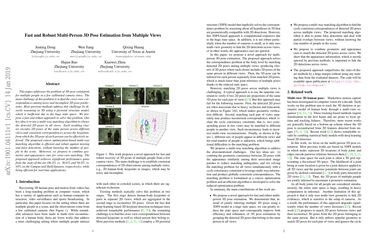
This paper addresses the problem of 3D pose estimation for multiple people in a few calibrated camera views. The main challenge of this problem is to find the cross-view correspondences among noisy and incomplete 2D pose predictions. Most previous methods address this challenge by directly reasoning in 3D using a pictorial structure model, which is inefficient due to the huge state space. We propose a fast and robust approach to solve this problem. Our key idea is to use a multi-way matching algorithm to cluster the detected 2D poses in all views. Each resulting cluster encodes 2D poses of the same person across different views and consistent correspondences across the keypoints, from which the 3D pose of each person can be effectively inferred. The proposed convex optimization based multi-way matching algorithm is efficient and robust against missing and false detections, without knowing the number of people in the scene. Moreover, we propose to combine geometric and appearance cues for cross-view matching. The proposed approach achieves significant performance gains from the state-of-the-art (96.3% vs. 90.6% and 96.9% vs. 88% on the Campus and Shelf datasets, respectively), while being efficient for real-time applications.
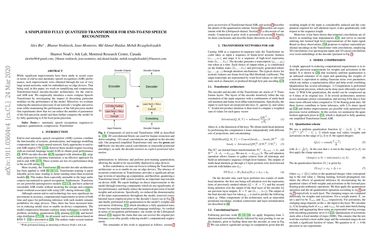
While significant improvements have been made in recent years in terms of end-to-end automatic speech recognition (ASR) performance, such improvements were obtained through the use of very large neural networks, unfit for embedded use on edge devices. That being said, in this paper, we work on simplifying and compressing Transformer-based encoder-decoder architectures for the end-to-end ASR task. We empirically introduce a more compact Speech-Transformer by investigating the impact of discarding particular modules on the performance of the model. Moreover, we evaluate reducing the numerical precision of our network's weights and activations while maintaining the performance of the full-precision model. Our experiments show that we can reduce the number of parameters of the full-precision model and then further compress the model 4x by fully quantizing to 8-bit fixed point precision.
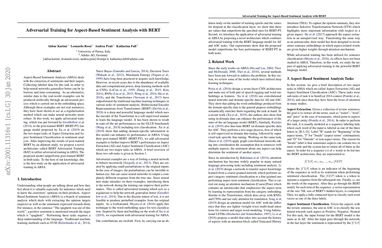
Aspect-Based Sentiment Analysis (ABSA) deals with the extraction of sentiments and their targets. Collecting labeled data for this task in order to help neural networks generalize better can be laborious and time-consuming. As an alternative, similar data to the real-world examples can be produced artificially through an adversarial process which is carried out in the embedding space. Although these examples are not real sentences, they have been shown to act as a regularization method which can make neural networks more robust. In this work, we apply adversarial training, which was put forward by Goodfellow et al. (2014), to the post-trained BERT (BERT-PT) language model proposed by Xu et al. (2019) on the two major tasks of Aspect Extraction and Aspect Sentiment Classification in sentiment analysis. After improving the results of post-trained BERT by an ablation study, we propose a novel architecture called BERT Adversarial Training (BAT) to utilize adversarial training in ABSA. The proposed model outperforms post-trained BERT in both tasks. To the best of our knowledge, this is the first study on the application of adversarial training in ABSA.
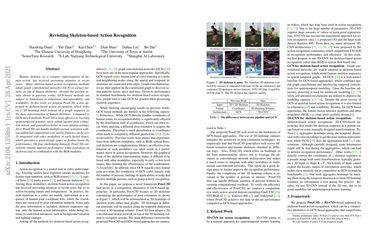
Human skeleton, as a compact representation of human action, has received increasing attention in recent years. Many skeleton-based action recognition methods adopt graph convolutional networks (GCN) to extract features on top of human skeletons. Despite the positive results shown in previous works, GCN-based methods are subject to limitations in robustness, interoperability, and scalability. In this work, we propose PoseC3D, a new approach to skeleton-based action recognition, which relies on a 3D heatmap stack instead of a graph sequence as the base representation of human skeletons. Compared to GCN-based methods, PoseC3D is more effective in learning spatiotemporal features, more robust against pose estimation noises, and generalizes better in cross-dataset settings. Also, PoseC3D can handle multiple-person scenarios without additional computation cost, and its features can be easily integrated with other modalities at early fusion stages, which provides a great design space to further boost the performance. On four challenging datasets, PoseC3D consistently obtains superior performance, when used alone on skeletons and in combination with the RGB modality.
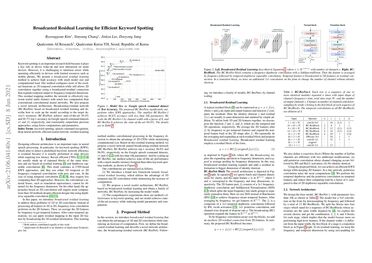
Keyword spotting is an important research field because it plays a key role in device wake-up and user interaction on smart devices. However, it is challenging to minimize errors while operating efficiently in devices with limited resources such as mobile phones. We present a broadcasted residual learning method to achieve high accuracy with small model size and computational load. Our method configures most of the residual functions as 1D temporal convolution while still allows 2D convolution together using a broadcasted-residual connection that expands temporal output to frequency-temporal dimension. This residual mapping enables the network to effectively represent useful audio features with much less computation than conventional convolutional neural networks. We also propose a novel network architecture, Broadcasting-residual network (BC-ResNet), based on broadcasted residual learning and describe how to scale up the model according to the target device's resources. BC-ResNets achieve state-of-the-art 98.0% and 98.7% top-1 accuracy on Google speech command datasets v1 and v2, respectively, and consistently outperform previous approaches, using fewer computations and parameters.
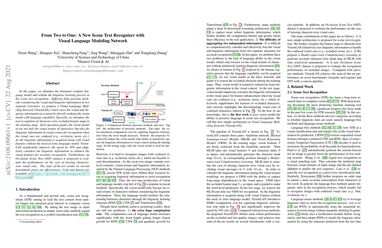
In this paper, we abandon the dominant complex language model and rethink the linguistic learning process in the scene text recognition. Different from previous methods considering the visual and linguistic information in two separate structures, we propose a Visual Language Modeling Network (VisionLAN), which views the visual and linguistic information as a union by directly enduing the vision model with language capability. Specially, we introduce the text recognition of character-wise occluded feature maps in the training stage. Such operation guides the vision model to use not only the visual texture of characters, but also the linguistic information in visual context for recognition when the visual cues are confused (e.g. occlusion, noise, etc.). As the linguistic information is acquired along with visual features without the need of extra language model, VisionLAN significantly improves the speed by 39% and adaptively considers the linguistic information to enhance the visual features for accurate recognition. Furthermore, an Occlusion Scene Text (OST) dataset is proposed to evaluate the performance on the case of missing character-wise visual cues. The state of-the-art results on several benchmarks prove our effectiveness. Code and dataset are available at https://github.com/wangyuxin87/VisionLAN.
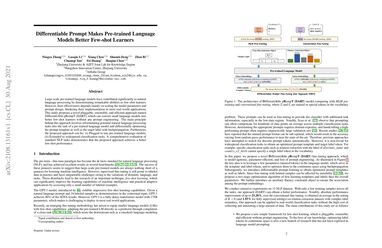
Large-scale pre-trained language models have contributed significantly to natural language processing by demonstrating remarkable abilities as few-shot learners. However, their effectiveness depends mainly on scaling the model parameters and prompt design, hindering their implementation in most real-world applications. This study proposes a novel pluggable, extensible, and efficient approach named DifferentiAble pRompT (DART), which can convert small language models into better few-shot learners without any prompt engineering. The main principle behind this approach involves reformulating potential natural language processing tasks into the task of a pre-trained language model and differentially optimizing the prompt template as well as the target label with backpropagation. Furthermore, the proposed approach can be: (i) Plugged to any pre-trained language models; (ii) Extended to widespread classification tasks. A comprehensive evaluation of standard NLP tasks demonstrates that the proposed approach achieves a better few-shot performance. Code is available in https://github.com/zjunlp/DART.
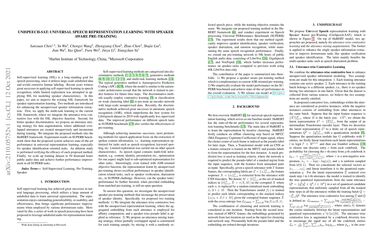
Self-supervised learning (SSL) is a long-standing goal for speech processing, since it utilizes large-scale unlabeled data and avoids extensive human labeling. Recent years witness great successes in applying self-supervised learning in speech recognition, while limited exploration was attempted in applying SSL for modeling speaker characteristics. In this paper, we aim to improve the existing SSL framework for speaker representation learning. Two methods are introduced for enhancing the unsupervised speaker information extraction. First, we apply the multi-task learning to the current SSL framework, where we integrate the utterance-wise contrastive loss with the SSL objective function. Second, for better speaker discrimination, we propose an utterance mixing strategy for data augmentation, where additional overlapped utterances are created unsupervisely and incorporate during training. We integrate the proposed methods into the HuBERT framework. Experiment results on SUPERB benchmark show that the proposed system achieves state-of-the-art performance in universal representation learning, especially for speaker identification oriented tasks. An ablation study is performed verifying the efficacy of each proposed method. Finally, we scale up training dataset to 94 thousand hours public audio data and achieve further performance improvement in all SUPERB tasks.
Recent studies have shown that multilingual pretrained language models can be effectively improved with cross-lingual alignment information from Wikipedia entities. However, existing methods only exploit entity information in pretraining and do not explicitly use entities in downstream tasks. In this study, we explore the effectiveness of leveraging entity representations for downstream cross-lingual tasks. We train a multilingual language model with 24 languages with entity representations and show the model consistently outperforms word-based pretrained models in various cross-lingual transfer tasks. We also analyze the model and the key insight is that incorporating entity representations into the input allows us to extract more language-agnostic features. We also evaluate the model with a multilingual cloze prompt task with the mLAMA dataset. We show that entity-based prompt elicits correct factual knowledge more likely than using only word representations. Our source code and pretrained models are available at https://github.com/studio-ousia/luke.

We introduce CogVLM, a powerful open-source visual language foundation model. Different from the popular shallow alignment method which maps image features into the input space of language model, CogVLM bridges the gap between the frozen pretrained language model and image encoder by a trainable visual expert module in the attention and FFN layers. As a result, CogVLM enables deep fusion of vision language features without sacrificing any performance on NLP tasks. CogVLM-17B achieves state-of-the-art performance on 10 classic cross-modal benchmarks, including NoCaps, Flicker30k captioning, RefCOCO, RefCOCO+, RefCOCOg, Visual7W, GQA, ScienceQA, VizWiz VQA and TDIUC, and ranks the 2nd on VQAv2, OKVQA, TextVQA, COCO captioning, etc., surpassing or matching PaLI-X 55B. Codes and checkpoints are available at https://github.com/THUDM/CogVLM.

The package High-dimensional Metrics (\Rpackage{hdm}) is an evolving collection of statistical methods for estimation and quantification of uncertainty in high-dimensional approximately sparse models. It focuses on providing confidence intervals and significance testing for (possibly many) low-dimensional subcomponents of the high-dimensional parameter vector. Efficient estimators and uniformly valid confidence intervals for regression coefficients on target variables (e.g., treatment or policy variable) in a high-dimensional approximately sparse regression model, for average treatment effect (ATE) and average treatment effect for the treated (ATET), as well for extensions of these parameters to the endogenous setting are provided. Theory grounded, data-driven methods for selecting the penalization parameter in Lasso regressions under heteroscedastic and non-Gaussian errors are implemented. Moreover, joint/ simultaneous confidence intervals for regression coefficients of a high-dimensional sparse regression are implemented, including a joint significance test for Lasso regression. Data sets which have been used in the literature and might be useful for classroom demonstration and for testing new estimators are included. \R and the package \Rpackage{hdm} are open-source software projects and can be freely downloaded from CRAN: \texttt{http://cran.r-project.org}.

Click-through rate (CTR) prediction is one of the fundamental tasks for online advertising and recommendation. While multi-layer perceptron (MLP) serves as a core component in many deep CTR prediction models, it has been widely recognized that applying a vanilla MLP network alone is inefficient in learning multiplicative feature interactions. As such, many two-stream interaction models (e.g., DeepFM and DCN) have been proposed by integrating an MLP network with another dedicated network for enhanced CTR prediction. As the MLP stream learns feature interactions implicitly, existing research focuses mainly on enhancing explicit feature interactions in the complementary stream. In contrast, our empirical study shows that a well-tuned two-stream MLP model that simply combines two MLPs can even achieve surprisingly good performance, which has never been reported before by existing work. Based on this observation, we further propose feature gating and interaction aggregation layers that can be easily plugged to make an enhanced two-stream MLP model, FinalMLP. In this way, it not only enables differentiated feature inputs but also effectively fuses stream-level interactions across two streams. Our evaluation results on four open benchmark datasets as well as an online A/B test in our industrial system show that FinalMLP achieves better performance than many sophisticated two-stream CTR models. Our source code will be available at MindSpore/models.