
 语音小管家
语音小管家项目地址:https://github.com/open-mmlab/Amphion
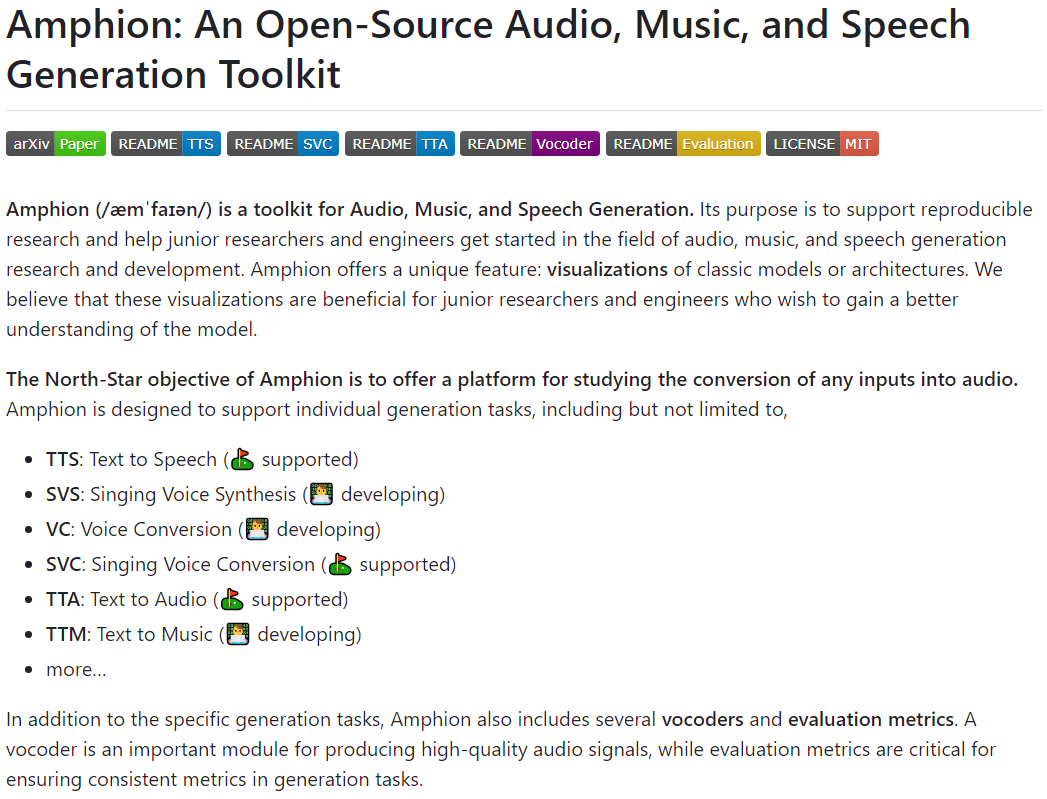

TTS: Text-to-Speech
FastSpeech2: A non-autoregressive TTS architecture that utilizes feed-forward Transformer blocks.
VITS: An end-to-end TTS architecture that utilizes conditional variational autoencoder with adversarial learning
Vall-E: A zero-shot TTS architecture that uses a neural codec language model with discrete codes.
NaturalSpeech2: An architecture for TTS that utilizes a latent diffusion model to generate natural-sounding voices.
Ampion supports multiple content-based features from various pretrained models, includingWeNet,Whisper, andContentVec. Their specific roles in SVC has been investigated in our NeurIPS 2023 workshop paper.
Amphion implements several state-of-the-art model architectures, including diffusion-, transformer-, VAE- and flow-based models. The diffusion-based architecture usesBidirectional dilated CNNas a backend and supports several sampling algorithms such asDDPM,DDIM, andPNDM. Additionally, it supports single-step inference based on theConsistency Model.
TTA: Text-to-Audio
Amphion supports the TTA with a latent diffusion model. It is designed likeAudioLDM Make-an-Audio and AUDIT.It is also the official implementation of the text-to-audio generation part of our NeurIPS 2023 paper.
Vocoder
Amphion supports various widely-used neural vocoders, including:
GAN-based vocoders: MelGAN, HiFi-GAN, NSF-HiFiGAN, BigVGAN, APNet.
Flow-based vocoders: WaveGlow.
Diffusion-based vocoders: Diffwave.
Auto-regressive based vocoders: WaveNet, WaveRNN.
Amphion provides the official implementation of Multi-Scale Constant-Q Transfrom Discriminator. It can be used to enhance any architecture GAN-based vocoders during training, and keep the inference stage (such as memory or speed) unchanged.
Evaluation
Amphion provides a comprehensive objective evaluation of the generated audio. The evaluation metrics contain:
F0 Modeling: F0 Pearson Coefficients, F0 Periodicity Root Mean Square Error, F0 Root Mean Square Error, Voiced/Unvoiced F1 Score, etc.
Energy Modeling: Energy Root Mean Square Error, Energy Pearson Coefficients, etc.
Intelligibility: Character/Word Error Rate, which can be calculated based on Whisper and more.
Spectrogram Distortion: Frechet Audio Distance (FAD), Mel Cepstral Distortion (MCD), Multi-Resolution STFT Distance (MSTFT), Perceptual Evaluation of Speech Quality (PESQ), Short Time Objective Intelligibility (STOI), etc.
Speaker Similarity: Cosine similarity, which can be calculated based on RawNet3, WeSpeaker, and more.
Datasets
Amphion unifies the data preprocess of the open-source datasets includingAudioCaps,LibriTTS,LJSpeech,M4Singer,Opencpop,OpenSinger,SVCC,VCTK, and more. The supported dataset list can be seenhere(updating).
📀Installation
gitclone https://github.com/open-mmlab/Amphion.git
cdAmphion

# Install Python Environment
condacreate --name amphion python=3.9.15
condaactivate amphion

# Install Python Packages Dependencies
shenv.sh
🐍Usage in Python
We detail the instructions of different tasks in the following recipes:
Text-to-Speech (TTS)
Singing Voice Conversion (SVC)
Text-to-Audio (TTA)
Vocoder
Evaluation
🙏 Acknowled
ming024's FastSpeech2 and jaywalnut310's VITS for model architecture code.
lifeiteng's VALL-E for training pipeline and model architecture design.
WeNet, Whisper, ContentVec, and RawNet3 for pretrained models and inference code.
HiFi-GAN for GAN-based Vocoder's architecture design and training strategy.
Encodec for well-organized GAN Discriminator's architecture and basic blocks.
Latent Diffusion for model architecture design.
TensorFlowTTS for preparing the MFA tools.
©️ License
Amphion is under theMIT License. It is free for both research and commercial use cases.
📚 Citations
Stay tuned, Coming soon
